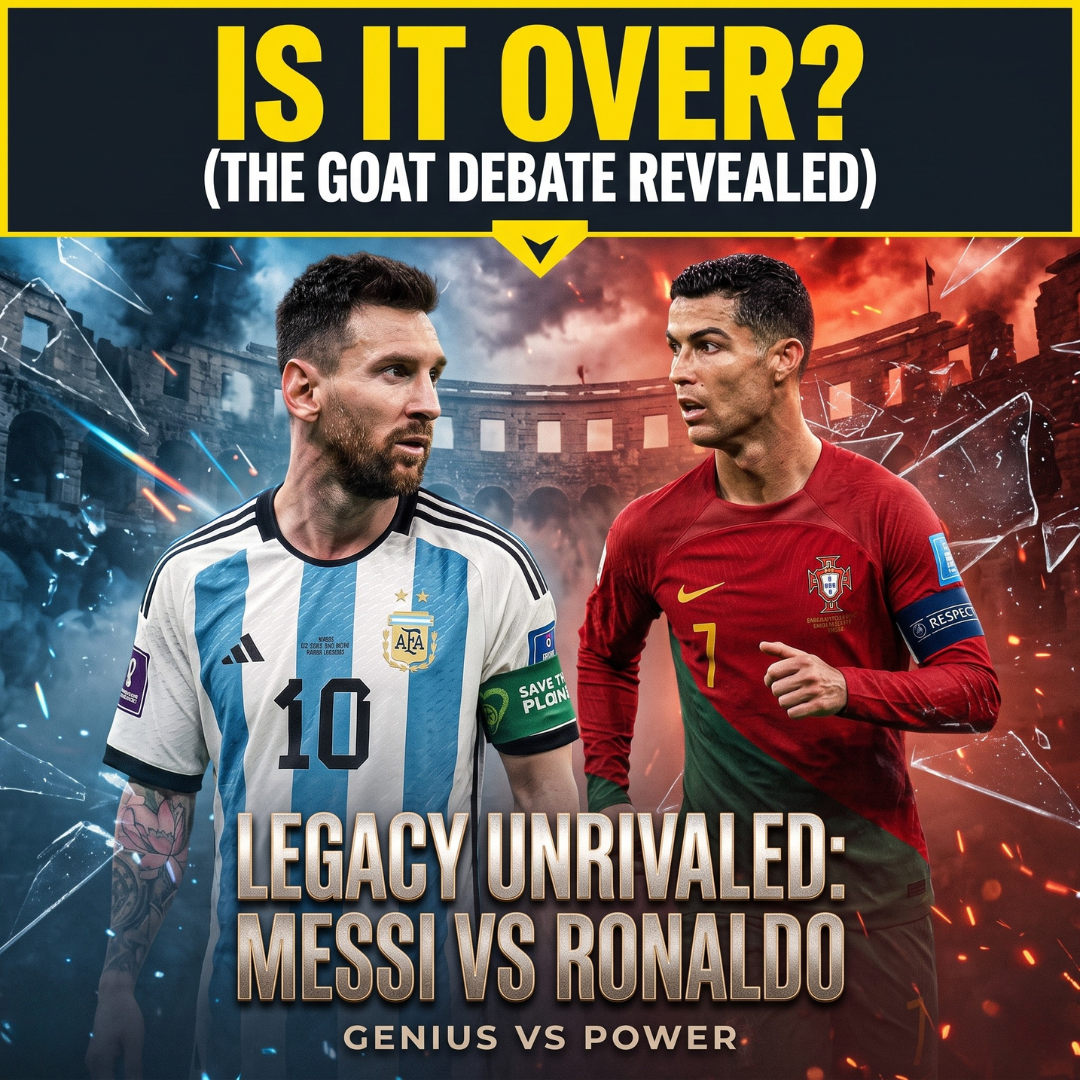
The locker room is silent. Real Madrid are about to play one of the biggest matches of the season, and the pressure in that room is thick enough to touch.
Then Cristiano Ronaldo stands up.
"Stay calm for the first fifteen minutes," he tells his teammates. "I will score the first goal. Just stay focused."
He scored.
Now picture a different locker room. Argentina. 2022 FIFA World Cup. The semifinal against Croatia. A 21-year-old named Enzo Fernandez, who had only a few months of top-flight European experience before this tournament, is about to step onto the biggest stage in world football.
He does not need a speech. He does not need to be told where to be or what to do. He plays with a freedom and confidence that stuns analysts across the globe. After the tournament, he wins the Best Young Player award. Within months, Chelsea pay a British transfer record to bring him to the Premier League.
Two locker rooms. Two different leaders. Two completely different things happening to the people around them.
And here, hidden inside what most people reduce to a GOAT debate, is one of the most useful leadership lessons you will ever encounter.
The GOAT Debate Is the Wrong Debate
Every four years, the FIFA World Cup reignites the same conversation. As the 2026 World Cup unfolds across the United States, Canada, and Mexico, the names Messi and Ronaldo inevitably surface in commentary booths, in barbershops, in office group chats. Their legacy casts a long shadow over this tournament, as it does over every one that follows their era.
That tells you something. Their influence outlasts their active competition. And the reason is not just their statistics, though the statistics are extraordinary. The reason is that both men changed the culture of every team they touched, just in completely different ways.
Messi changed Argentina forever. The generation of players who won the 2021 Copa America and the 2022 World Cup did not just win because of what Messi did on the pitch. They won because of what he did to them: to their confidence, their identity, their belief that Argentina could finally lift that trophy.
Ronaldo changed the DNA of Real Madrid's training culture, pushed Juventus to a standard of physical preparation they had never seen, and carried Portugal through tournament matches on force of will alone.
"They are not just two great players. They are two competing models of how a leader creates results through other people."
Understanding the difference between those two models is worth far more than settling a debate about who deserves more Ballon d'Or trophies.
Messi and the Art of Making Everyone Around You Better
December 18, 2022. The FIFA World Cup Final in Lusail, Qatar, has just ended. Argentina have beaten France on penalties. The photograph that circulates most widely is not Messi lifting the trophy alone. It is Messi surrounded: arms around teammates, buried under a pile of players who look less like professionals celebrating a trophy and more like children who just realized they can fly.
That photograph is a leadership document.
Liz Wiseman, in her book Multipliers, describes a category of leaders who have a particular gift. They make the people around them smarter, more capable, and more confident. Not by doing more themselves, but by creating the conditions in which others can do more. She calls them Multipliers.
Messi is a textbook Multiplier. His 453 career assists are not just a statistic. They are evidence of a man who, at the moment of maximum leverage, consistently chose to give the moment to someone else. He yields penalties to struggling teammates. He passes to an open player in front of an empty net. He creates space that draws defenders toward him so that someone else can finish.
"A Multiplier does not shrink to make others feel big. They simply refuse to shrink others in order to feel big themselves."
John Maxwell captures the same truth in The 21 Irrefutable Laws of Leadership through the Law of Addition. Leaders add value by serving others. The greatest leaders are not measured by how much they produce personally, but by how much they increase the production of everyone around them.
The most effective leaders do not add value by doing more. They add value by increasing what everyone around them is capable of doing. When you lead from a place of security, you create space for others to grow into their potential.
What makes Messi's model powerful is not just the tactics. It is what happens to people psychologically when they play alongside him. Former teammates describe a family atmosphere. That phrase sounds soft until you realize what it actually produces: psychological safety, the freedom to take creative risks without fear of public humiliation, and the belief that you belong at this level.
That belief is what turned Enzo Fernandez from a relatively unknown midfielder into a World Cup winner. It is what turned Alexis Mac Allister into one of the most sought-after midfielders in European football. It is what happens when a leader's identity is secure enough that they do not need to be the center of gravity in every moment.
From Maxwell's 17 Essential Qualities of a Team Player, Messi embodies adaptability, selflessness, and intentionality. He reads what the team needs in a given moment and adjusts accordingly. He does not force the game. He serves it.
Ronaldo and the Power of an Unbreakable Standard
Stories of Cristiano Ronaldo's training habits have circulated through the football world for two decades. Coaches, teammates, and club staff at Manchester United, Real Madrid, and Juventus have all described the same phenomenon: after everyone else has finished, Ronaldo keeps going.
This is not a story about obsession for its own sake. It is a story about identity.
Ronaldo does not maintain that standard because a coach tells him to. He maintains it because of who he believes he is and who he believes he is obligated to be. That distinction matters enormously, because it is the same distinction that separates leaders who inspire from leaders who simply demand.
Wiseman's framework would describe Ronaldo as a Maximizer. He maximizes his own output with a consistency that sets a standard most people have never encountered in a teammate. And that standard, when it meets the right culture, can be genuinely transformational.
"Ronaldo does not raise the bar and then walk away from it. He lives at the bar. And eventually, the people around him start to ask whether they can live there too."
Maxwell's Law of the Lid states that your leadership ability determines your level of effectiveness. What Ronaldo demonstrates is that a leader who refuses to lower his own lid creates a gravitational pull toward excellence. When the most gifted player in the room is also the hardest worker in the room, it becomes difficult for anyone to justify a lower standard.
Former teammates at Real Madrid described something worth noting. They felt a certain accountability simply being around him. Not the threatening kind, but the kind that comes from being near someone whose commitment to excellence is impossible to ignore. That kind of accountability, when it comes from demonstrated excellence rather than ego, can transform a team's culture.
When a leader models an uncompromising standard of excellence over a sustained period, they raise the lid on what the people around them believe is possible. The risk: this only works when the culture already has a foundation of trust. Without it, accountability without safety produces fear, and fear kills creativity.
From Maxwell's 17 Essential Qualities, Ronaldo embodies competence, relentlessness, and preparedness. He does not arrive at a match hoping his talent will be enough. He arrives having already done more preparation than the situation seems to require.
Side by Side: Two Models, Both Elite
| Leadership Lens | Messi — The Multiplier | Ronaldo — The Maximizer |
|---|---|---|
| Core Drive | Elevate those around him | Maximize his own output |
| Influence Model | Distributed ownership | Centralized authority |
| Trust Formula | Trust → Confidence → Performance | Standards → Accountability → Performance |
| Maxwell Law | Law of Addition | Law of the Lid |
| Wiseman Frame | Multiplier | Maximizer |
| Team After Departure | Others step up; they were built for it | Vacuum forms; the team relied on him |
| Best Context | Culture-building, long-term growth | Crisis, turnaround, short sprints |
So Which One Should You Be?
Here is where most leadership content takes a wrong turn. It declares a winner. It tells you that Messi's model is better for modern organizations and then gives you a checklist of things to do differently starting Monday morning.
But the honest answer is more useful than a winner.
The honest answer is: it depends on who you are, and it depends on what your team needs right now.
Consider two leaders at the same company.
The first is a department head who has spent three years quietly developing her team. She hands off high-profile projects to junior analysts, advocates for them in rooms they are not yet in, and creates the conditions for three of her direct reports to be promoted in the same year. Her team's output is extraordinary. When she eventually moves to a new role, her team does not collapse. They step up. Because she built them to.
The second is a sales director who joined during a crisis. Revenue was down forty percent. The team had lost its belief. He walked in, set a standard that felt almost unreasonable, and then hit it personally, week after week, quarter after quarter. The team rallied around his standard. They did not just recover. They broke records.
Two different leaders. Two different moments. Both exactly right for what the situation demanded.
What separates both of those leaders from average performers is not the model they used. It is the self-awareness to know which model the moment required, and the identity security to execute it without needing external validation.
Messi's model fails when a team needs decisive individual leadership and no one steps forward because everyone is waiting to empower someone else. Ronaldo's model fails when the team needs creative freedom and instead gets performance anxiety because no one feels safe enough to try something new.
The leaders who endure over time are fluent in both languages. They know when to give the moment away and when to take it. They know when to raise the standard and when to raise the confidence. Jim Collins described this quality in Good to Great as the hallmark of the most durable leaders: fierce resolve combined with personal humility.
"The 2026 World Cup will produce new heroes. But the leaders who built the teams those heroes play on are the story worth studying."
The Question Behind the Question
Here is what this analysis ultimately comes down to. And it is the question most leadership content is too polite to ask directly.
What kind of leader are you defaulting to right now? And is that default a conscious choice, or is it simply the path of least resistance?
Messi does not lead the way he does because someone taught him a collaboration framework. He leads the way he does because of who he is. His identity is rooted in something deep and secure enough that he does not need to take every moment for himself.
Ronaldo does not set the standard he sets because a performance coach handed him a discipline routine. He sets it because he has decided, at the level of identity, that he is the kind of person who does not accept less than his best. And then he lives that decision every single day.
"Your leadership style is not a strategy you choose. It is the overflow of the identity you have built. And the identity you are building right now — through every decision you make under pressure, every moment you hand away, every standard you hold when no one is watching — is shaping the kind of leader your team will remember."
That is the real lesson in the Messi and Ronaldo story. Not who scored more goals. Not who won more trophies. The real lesson is this: the most effective leaders know who they are clearly enough to lead from that place consistently, and securely enough to become what their team needs even when it costs them the spotlight.
That kind of leadership does not start with a strategy. It starts with an identity.
Find out what kind of leader you are building yourself to be
If this piece has you thinking about your own leadership identity — the defaults you fall back on under pressure, whether you are truly multiplying or just managing — the Leader Identity Audit is the next step. Free. Specific. Takes 15 minutes.
Get My Free Audit